Hand-peened #9 solid copper rivets lock front-pocket stress corners by clamping fabric between a 9.5 mm burr washer and mushroomed post, while a Union Special 43200G pulls the upper cuff layer slower than the lower hem to form 45-degree diagonal roping ridges after the first wash.
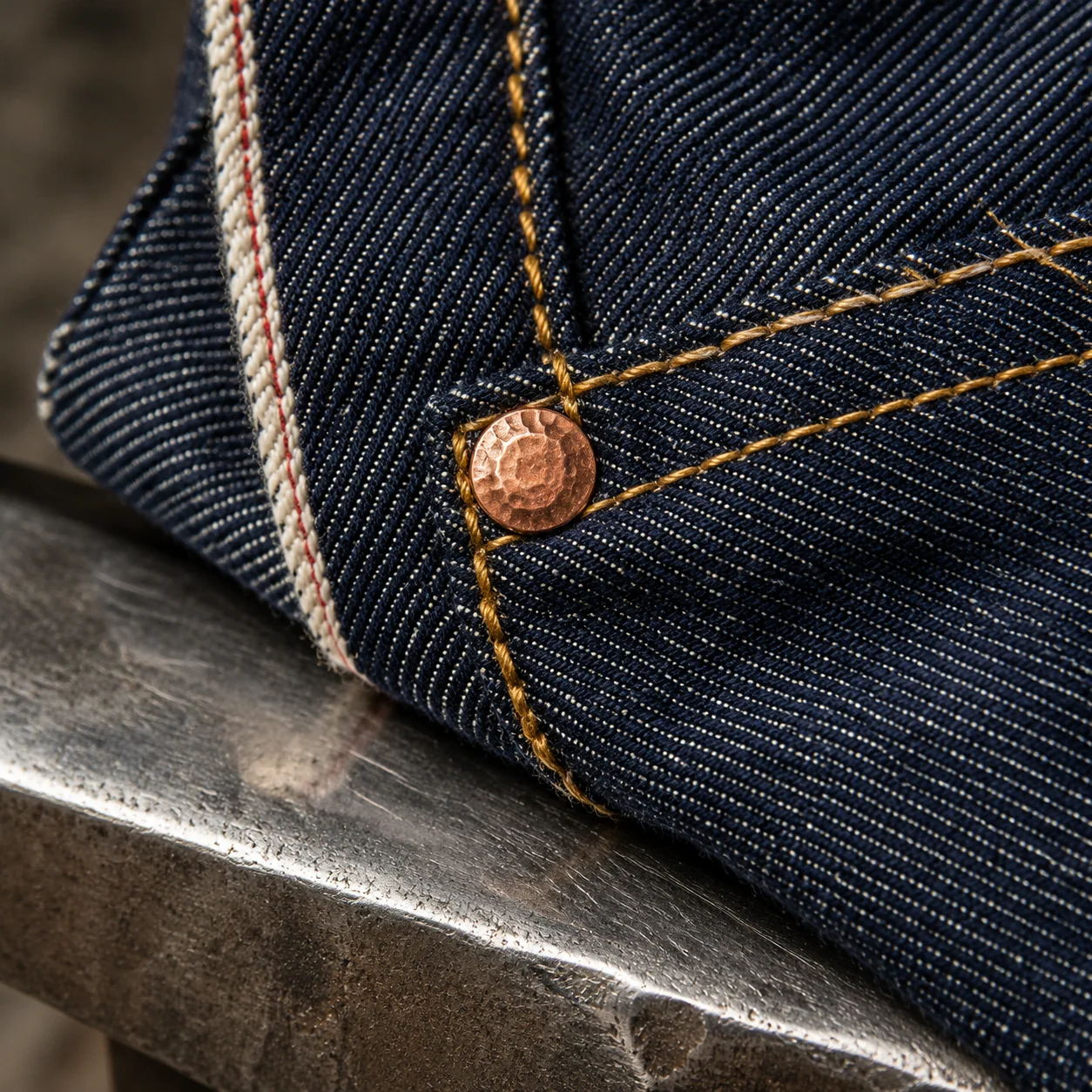
1. Solid Copper Burr Rivet Assembly
Two-piece solid copper rivets distribute shear loads across multi-layer pocket intersections without cutting warp threads. After punching an awl opening between weave yarns rather than severing them, the bench mechanic seats a #9 copper tack post through the pocket bag and outer 16oz twill, presses a flat copper burr washer tight with a setting tube, snips excess shaft 2.0 mm above the washer, and mushrooms the copper tip over a brushed steel anvil with a ball-peen hammer.
2. Union Special 43200G Roping Mechanics
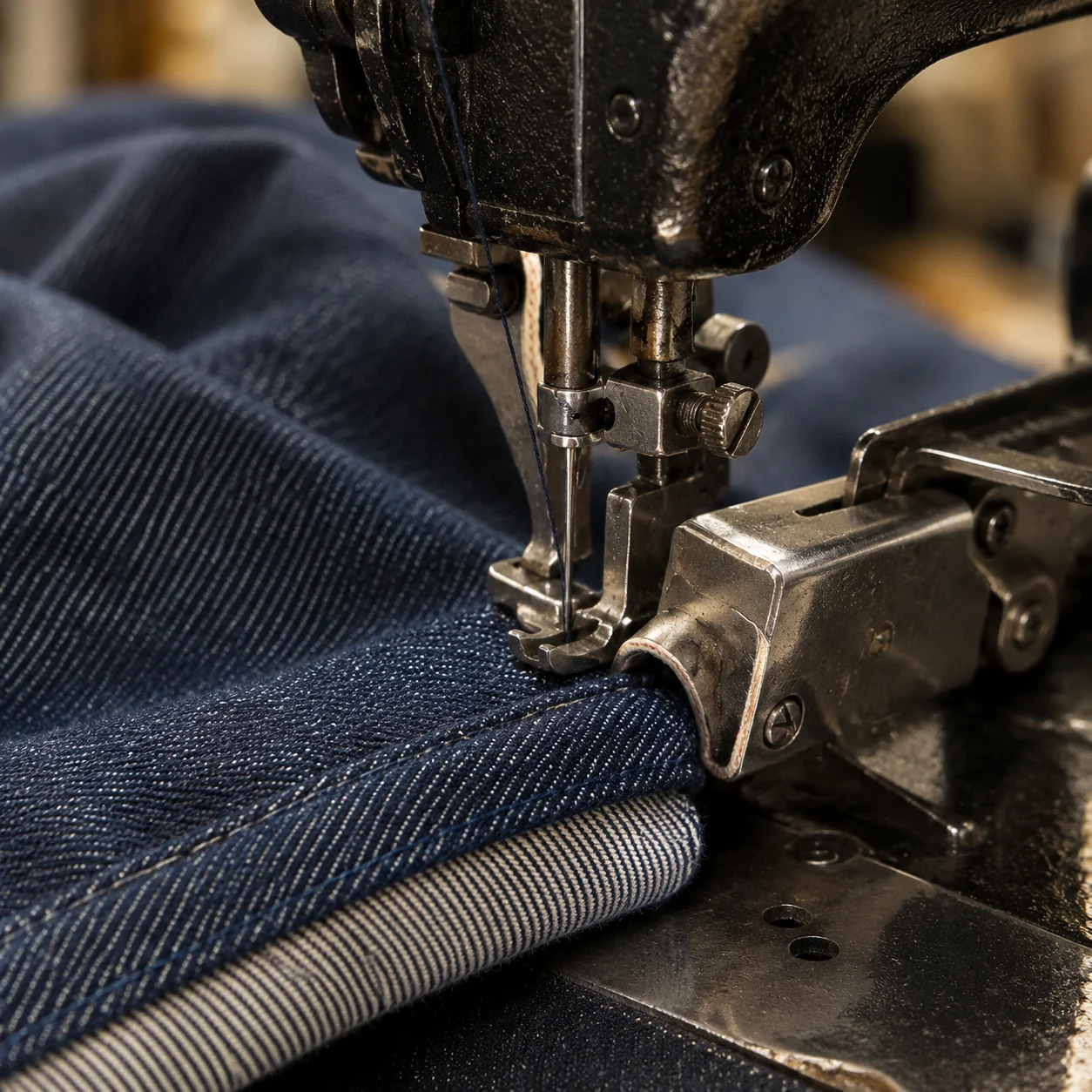
Originally built as a dedicated high-speed hemming machine, the cast-iron Union Special 43200G pairs a curved spiral folder with mismatched upper and lower feed tension. As the folded selvedge cuff enters the folder, the inner folded ply advances slightly faster than the outer face while the single-needle looper forms a two-thread 401 chain-stitch underneath. Once washed, cotton chain-stitch thread contracts along a skewed vector against the twill, pulling the hem fold into permanent diagonal ridges known as roping.
3. Workwear Hardware & Stitch Specification Table
| Component / Seam | Gauge / Machine Spec | Thread Weight / Material | Stitch Density | Primary Failure Mode Prevented |
|---|---|---|---|---|
| Pocket Corner Rivet | #9 Solid Copper Post & Burr | 9.5 mm washer, 2.0 mm peen | 1 per stress corner | Pocket corner bar-tack tearout |
| Leg Hem (Roping) | Union Special 43200G (401) | #6 / #8 Cotton or Poly-Core | 7 - 9 stitches/inch | Cuff seam blowout on boot heel |
| Yoke & Inseam Felled | Union Special 35800 Feed-Off-Arm | #20 Upper / #30 Looper | 8 - 10 stitches/inch | Seat & thigh seam shear |
| Blowout Warp Darning | Singer 47w70 / Juki LZ-271 | #50 Mercerized Cotton Indigo | 14 - 18 passes/cm | Crotch & knee weft abrasion split |
4. Structural Warp-Darning Protocol
When indigo warp floats wear thin across high-flex zones, patching with heavy non-woven iron-on backing creates a rigid border that tears adjacent denim within weeks. Proper workshop restoration removes loose lint, aligns a lightweight unbleached cotton twill stabilizer underneath, and lays dense parallel cotton darning rows strictly parallel to the original warp grain so repaired cloth flexes uniformly with surrounding 3x1 twill.